What UAP & Nature Teach Us About Resilience

By Lisa Puzo Strickland, PhD
July 2026 Edit of Original Publication in TheWowSignal.news
Throughout his career, Rear Admiral Tim Gallaudet, U.S. Navy (Ret.) has withstood myriad hardships and tests of his perseverance including navigating career transitions, complex situations, and the infamous "Sharpiegate" - experiences that forged the resilience he now brings to leading with integrity and purpose.
In his new book, Holding Fast in Heavy Seas, Gallaudet humbly writes of a realization he had during a particularly difficult time while working with the National Oceanic Atmospheric Administration (NOAA):
“Whether personal or professional, more storms were sure to come, and I knew that I had what it takes to be a servant leader and help NOAA weather whatever lay ahead.”
Gallaudet’s resilience illustrates the kind of fortitude and buoyancy required in times of uncertainty and confusion, emotions many will experience upon the official disclosure of unidentified anomalous phenomena and non-human intelligence.
Today, Gallaudet stands on the bridge of the UAP movement, actively pushing for whistleblower protections and emboldening the U.S. government to continue its release of UAP related files.
He understands that humans have the right to know - while mental health care professionals prepare for what will happen when we do know.
In fact, there is growing concern amongst psychologists worldwide regarding pending disclosure.
Several world governments, namely the United States and the United Kingdom, understand that the actuality of UAP and NHI could potentially tip our current understanding of reality onto its side and are attempting to establish psychological protocols to better prepare humanity for the paradigm shift ahead.
They fully grasp that individual and public resilience must be strengthened beforehand to lessen the chaos that will surely accompany the sudden squall of UAP confirmation.
The White Papers
The newly formed U.S. UAP Scientific Advisory Council (of which Gallaudet is an appointee) recently published a white paper titled, “The Psychological Impact of UAP/NHI Disclosure”, authored by Dr. Jennice Vilhauer, et al.
This came just days after the U.K.-based Unhidden organization released its report, “Preparing for Disclosure: A Public Health Framework for Paradigm-Shifting Revelations”, written by founder John Priestland and his contributors.
The guidelines in both reports are similar, urging world leadership to prepare for a possible surge in health and mental health care needs that will most likely be apparent when a notable head of government, such as the President of the United States, confirms the existence of UAP and NHI.
Therefore, psychological preparedness via public education regarding the phenomena is crucial for individual and global resilience to be sustainably built, because without that resilience, we are left susceptible to deceptive practices, errorneous explanations, and emotionally triggering circumstances.
Stronger Siding
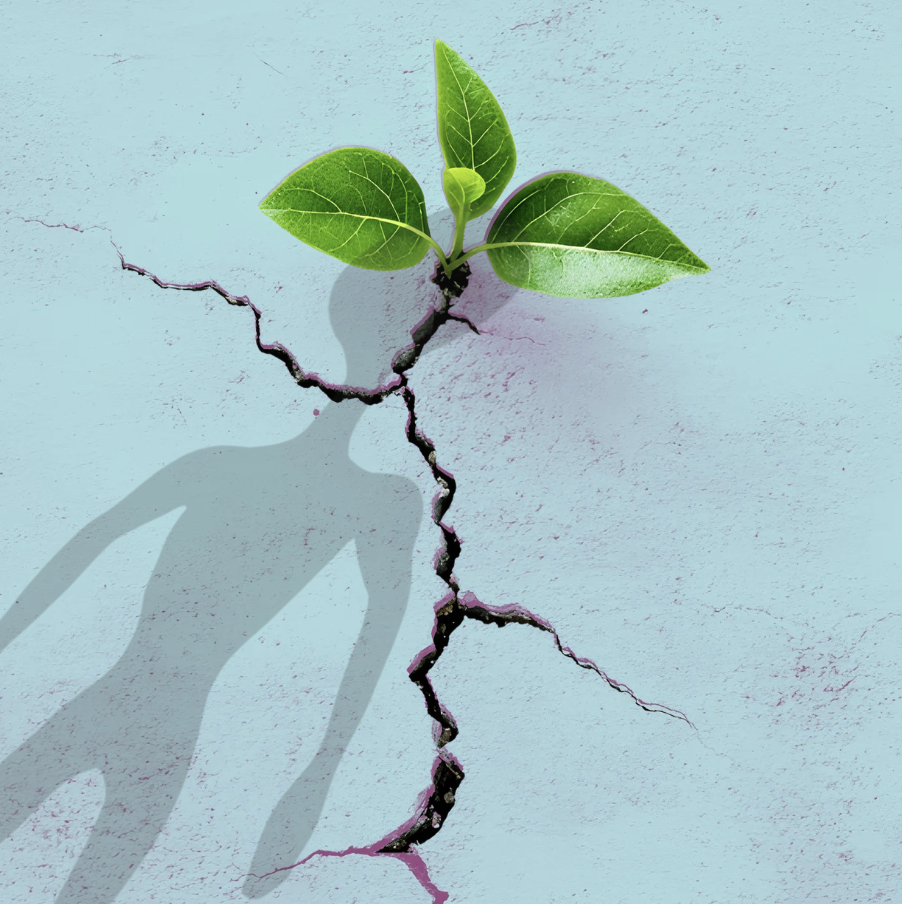
Resilience is the capacity to adapt, recover, and grow in response to a challenge or adversity. It allows us to withstand the storm while enjoying the wind on our face. And it is a force that offers as much balance as it does direction.
Nature provides many examples of resilience.
In the winter, plants enter a state of dormancy to conserve energy. The stored sugars created during the warmer months act as a natural antifreeze to prevent cell damage from the cold. Here we see how nature predicts and protects.
Likewise, when the fish are plentiful, heron appear, but when the fish are scarce, heron relocate thus illustrating nature’s adaptability.
But resilience is not always inherent. In humans, it is often experientially structured through life experiences, like shipyard scraps melted down and remolded into stronger siding.
When disclosure occurs, it will upend our classical views of many sciences and philosophies, so a palpable amount of fear and perplexity will naturally be felt throughout global populations, with higher risk groups being more vulnerable to fear’s grip.
Those who are inadequately educated about UAP and NHI, or are resistant to the data, are considered higher risk because they may more deeply experience fear and other potential effects of the resulting ontological shock. These groups are a focus of such advocacy organizations as Unhidden and OPUS, the Organization for Paranormal Understanding and Support.
However, those more thoroughly informed will have an easier time cognitively absorbing and assimilating this new reality. Fear will be manageable. Therefore, these groups are less at risk.
A Path to Resilience
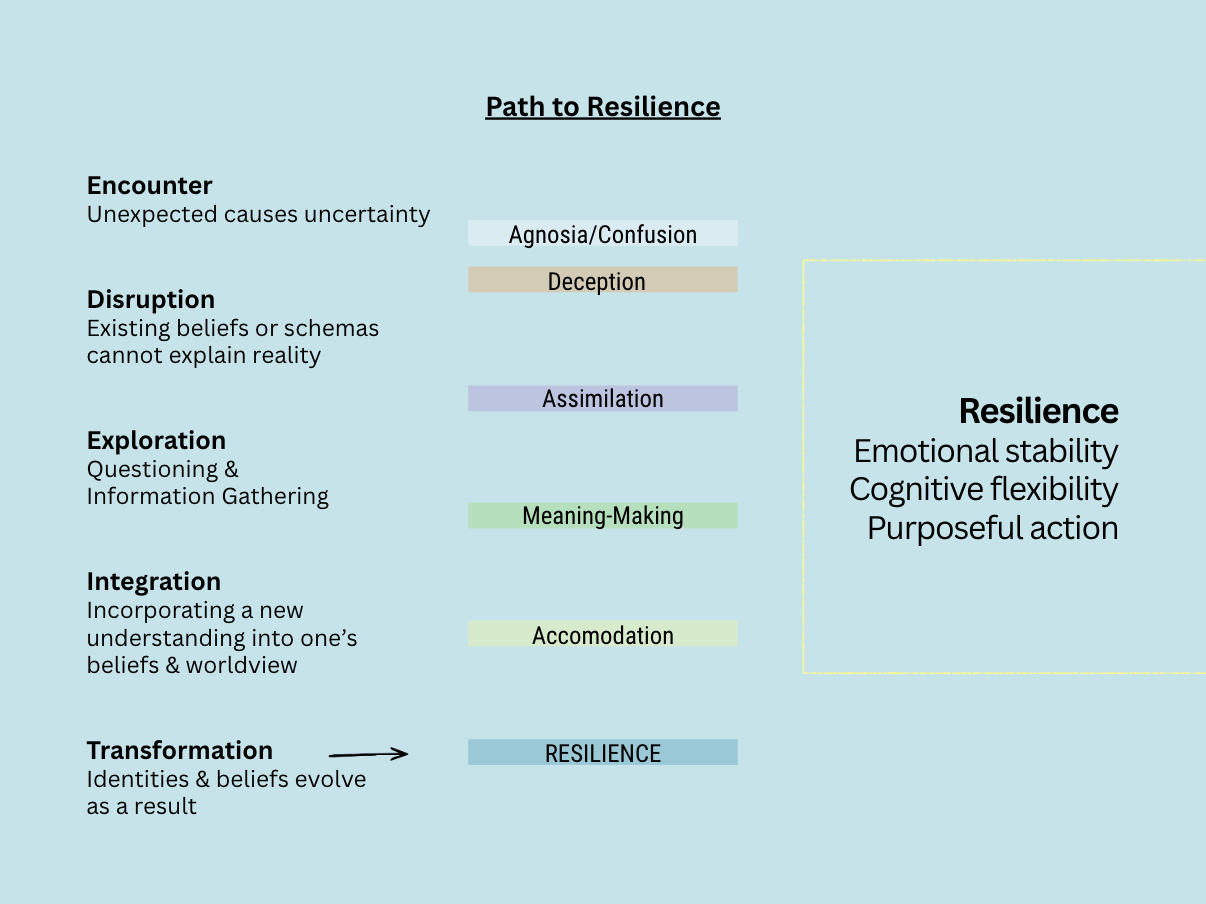
Understanding the cognitive pathway from disruption to resilience may offer revelatory insight.
We start at the Encounter itself, when we see or hear something unexpected that naturally leads to uncertainty or fear. This could be a UAP sighting or an experience with NHI - or a voice of authority verifying the phenomenon is real.
Uncertainty creates agnosia or confusion and is mentally disruptive because we are unable to immediately resolve the unknown or properly assimilate the new intel into an existing framework of understanding.
It is at this point of disruption that we are in our most vulnerable state and subject to fear-based tactics and false narratives, aka deception.
Bad actors who wish to deceive the public and prevent the truth regarding the phenomena from becoming entirely known or accepted will take advantage of the space between the disruptive phase and the moment facts and logic can take root.
These deceivers, whether they are acting solely or within an organization, zing their deceptions into the human psyche before a person or society has the chance to question or consider truth-based possibilities that may exist outside of our current schemas.
This is why, when there is a UAP sighting, the military or another authority may quickly jump in with sensationalist claims of “drones” or “weather balloons” before UAP experts can offer their views and true facts be reasonably considered.
If, however, a person can safeguard against such deceptions and functionally incorporate the UAP facticity into their beliefs and worldviews, they have reached the point of accommodation.
It is during the accommodation phase that one can begin to make sense of the experience and attach their own personal significance or meaning to it.
Meaning-making is how humans interpret experiences, events, relationships, and information and decide how those experiences fit into their own view of themselves and the world around them.
So, one’s questions may develop from What is that? to How does this change my life and beliefs?
Meaning-making can then lead to transformation or personal evolvement which cultivates our resilience against further disruptions and deceptions.
The Roles of Resilience
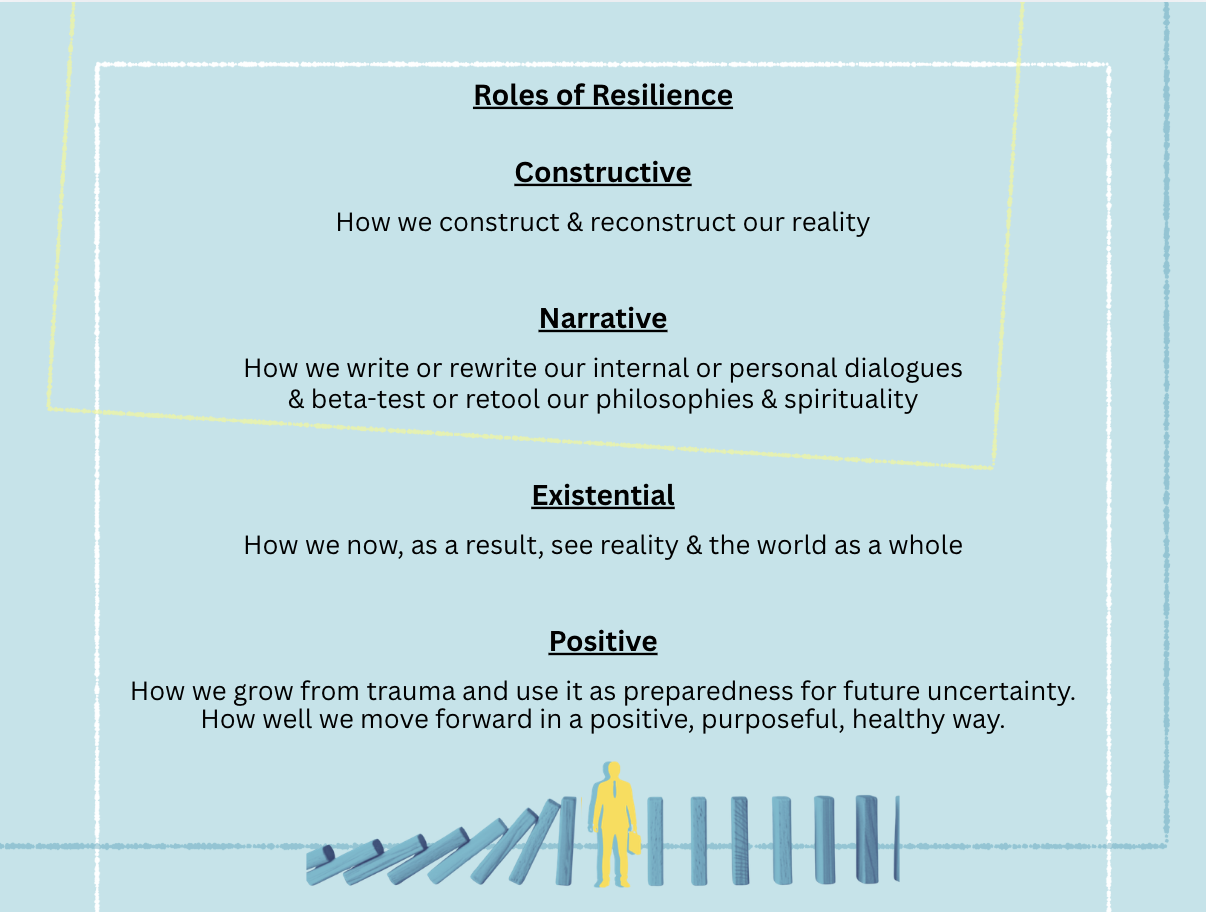
Resilience is multi-purposed. Besides acting as a protective barrier against threat or deceit, it aids in the construction and reconstruction of our perceptions as well as our internal and external narratives.
When we are confronted with something strange or fundamentally different, the experience can alter the landscape of our beliefs, philosophies, and dialogue, requiring us to reexamine and, in a sense, beta-test what we believe about ourselves and the world around us.
Allowing ourselves to practice a bit of psychitecture is healthy and fosters our ability to not only question but to reinvent or transform. And it encourages us to see life as an interconnected whole, filled with purpose - and meaning.
Fair Winds
The continuance of life on Earth has largely depended upon our resilience and capacity to transform.
Entire civilizations have been dislocated by natural disasters. Jellyfish have endured massive climate changes for 500 million years. And over 3 million European Jews survived the Holocaust.
Resilience has served us well, and if further developed and integrated, will help us ride the swells of disclosure.
As Dr. Vilhauer and her coauthors express, “Confirmation that some UAP are not of known human origin, or that NHI exists, would be unprecedented. But there is little reason to assume it would exceed our capacity to eventually adapt.”
Humanity has very much proven its adaptability and we are more than ready to, again, “weather whatever lay ahead.”
Sail well!
-LPS
Sources:
Gallaudet, Timothy, Holding Fast in Heavy Seas, Koehler Books, 2026. Available on Amazon.
Vilhauer, Jennice, et al. (June 2026). The Psychological Impact of UAP/NHI Disclosure, Disclosure Foundation. https://disclosure.org/research/psychological-impact-of-uap-nhi-disclosure
Priestland, John, et al. (June 2026). Preparing for Disclosure: A Public Health Framework for Paradigm-Shifting Revelations, Unhidden Foundation. https://www.unhidden.org/preparedness-plan/