How on earth do we tell the kids about uFOs?
By Lisa Puzo Strickland, PhD As appears in Medium.com
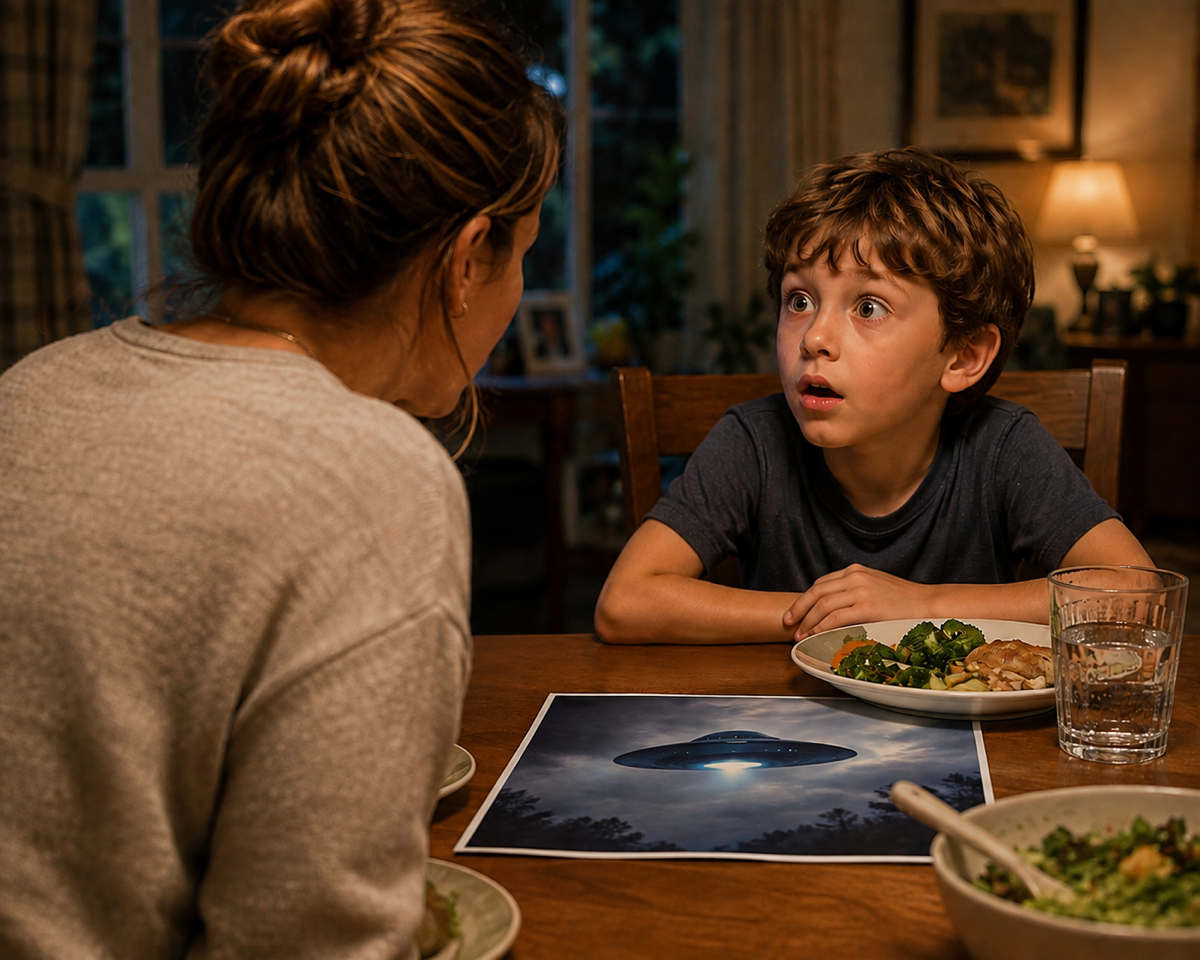
Picture this: A young child overhears his mother discussing UFOs with a friend. Later, during dinner, the child asks, “Mom, are aliens real?”
The mother is unsure how to answer this monumental question, so she hurriedly replies, “They may be real, but I’m not sure they really kidnap people or anything like that. But don’t worry, honey, everything will be fine.” And with that, she changes the subject.
This is not how to talk to your child about UFOs.
In this response, the mother uses the word kidnap which, sans proper explanation, can be a scary concept for a child. She also assures, “everything will be fine”. However, by not defining exactly how or why things will be fine, uncertainty may inadvertently be introduced, prompting the child to consider the possibility that things may not, in fact, be fine.
Perhaps the most damaging part of this response is the mother abruptly changing the subject. This one act negates the child’s intellect and squashes their curiosity.
So, how do we talk to our children about unidentified anomalous phenomena (UAP) and non-human intelligence (NHI), or aliens?
. . . . .
The truth is what little we know about the phenomenon can be interpreted myriad ways.
The disappearance and instant reappearance of a craft may be fascinating to a scientist but frightening to a witness. Or, a set of glowing orbs that float above a field and then suddenly shoot up to the sky at physics-defying speeds may be breathtaking to onlookers but considered a national security threat by the military.
For these and many other reasons, the information we choose to share with younger minds needs to be accurate and relevant.
In addition, our own disposition plays a key role in how well our child both absorbs and interprets the new insights.
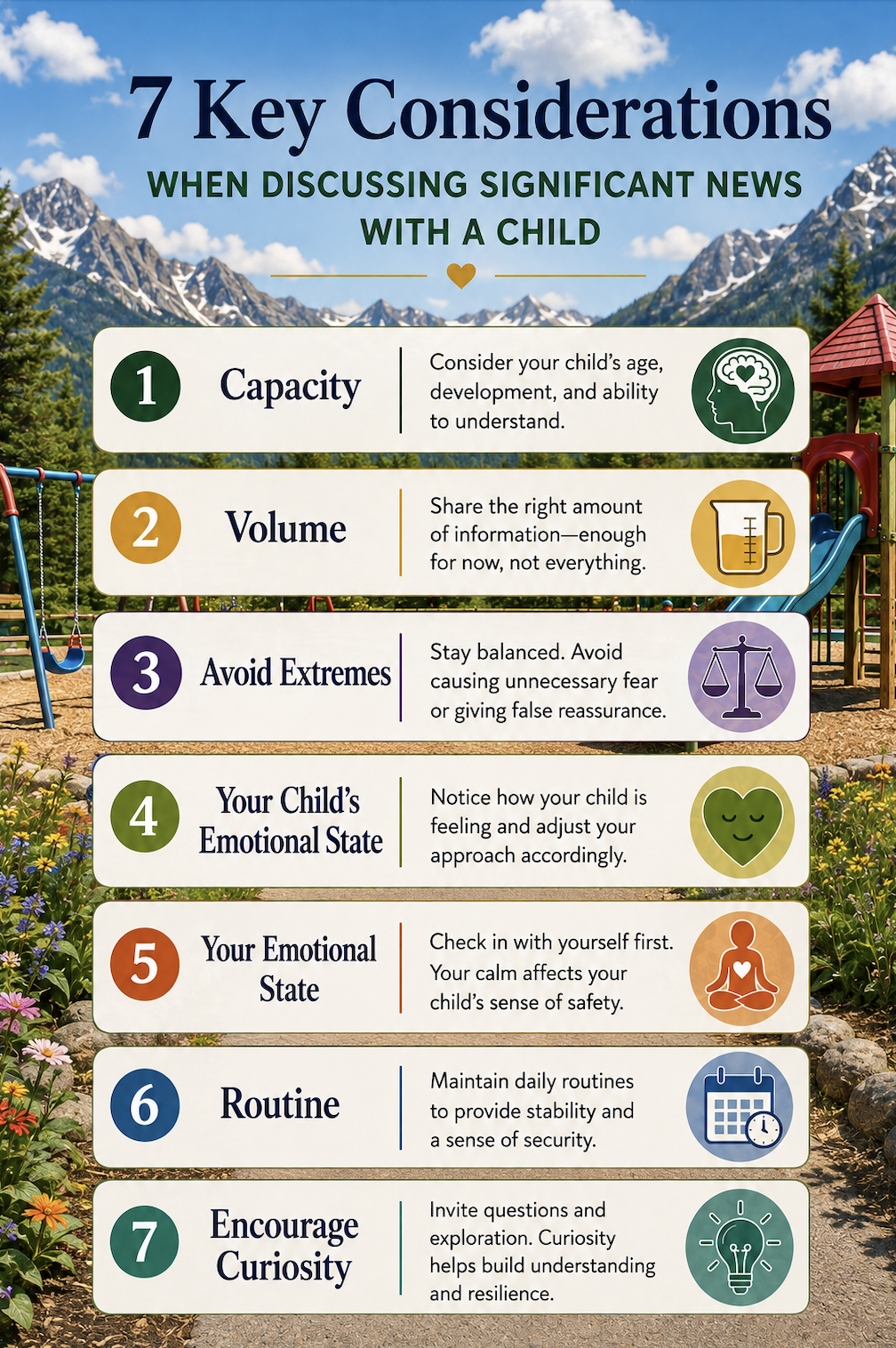
Here are 7 key considerations when discussing UAP and NHI with children:
First, capacity.
Consider the age of your child, or more specifically, their cognitive capacity. If he or she plays complex video games or can demonstrate abstract thinking and effective reasoning, they may be able to comprehend more intrinsic details regarding UFOs then a child who is less cognitively developed.
Older children can normally differentiate between probability and uncertainty as well as dissect complicated verbiage. But a five-year-old may require more ordinary statements such as, “It’s fun to look up at the stars and imagine what’s up there,” or “The universe is gigantic and full of surprises!”.
Second, volume.
More is good, but sometimes less is more. Keep to what the child is explicitly asking about and don’t fill their mind all at once with everything you know. State a fact, then allow some breathing room for their contemplation and further questions.
Third, avoid extremes.
Apply factual restraint. Understating the truth can be too ambiguous, while overstating can lean alarming. Find that happy medium for your child. Perhaps show only images that fit their maturity level, and refrain from sensationalized depictions that could induce unnecessary fear.
Fourth, consider your child’s emotional state.
Your child’s general temperament and current situation should dictate your words and delivery. For instance, if there is anything going at home or school that could be causing insecurity or inhibition, you don’t want to add to their present tension. This is where empathy comes in: stepping into your child’s world to see and feel life through their eyes and through their emotions. In fact, when we practice empathy with anyone, it fosters both validation and feelings of safety and security.
Fifth, consider your emotional state.
When discussing big topics like UFOs, you should be calm, not just acting calm, because kids don’t miss a trick. Children unconsciously practice social referencing, meaning they see our facial cues and hear our vocal tones to complete the entirety of the conversation. If your words say one thing but your expression says another, the result can be cognitive dissonance which can inadvertently invoke fear and distrust within the listener.
To naturally guide your facial movements and vocal nuances, make sure you have this discussion when you are in a composed state of mind, are prepared to stick to the facts, and are not vulnerable to the sways of speculation or enhanced emotion. Remember, this conversation can become a trust-building moment between you and your child, so speak calmly and cite only what you believe to be true.
Sixth, routine.
The UFO conversation can leave a child mentally wobbly because the grounded perception they once had about the universe has just been tremored a bit with a cosmic revelation. Preserve normalcy by maintaining daily routines such as homework, chores, and regular play time. When we anchor revealing insights with routine functions, it aids intellectual digestibility.
Seventh, encourage curiosity.
By asking your child questions like, “What do you think UFOs are?” or “What do you believe?”, you are essentially granting them permission to formulate their own opinions and panoramic perspectives. This is an essential part of meaning-making.
You are also teaching them the power and necessity of being inquisitive. Highlight what scientists and researchers have presented as evidence but be honest about the limits of humankind’s current UAP understanding — because discretion is vital, and when we adults are discerning, we are teaching our children to be as well.
One additional tip I will offer - so you’re not caught off guard when your child suddenly asks a question from the back of the car - is to have at least five well-versed facts on hand.
Here are some ready-to-go examples:
Some of the smartest scientists in the world believe we are not alone in the universe, and right now they are researching what might be out there. So, someday soon we may know more about our reality than any previous generation has ever known.
Tens of thousands of witnesses have seen UFOs in the sky, including trained military personnel, police officers, and government officials.
Sometimes what we think is a UFO is actually a human-made drone or satellite, but sometimes what we think is a drone or satellite is something else that humanity does not yet have the technology to create.
People all around the world for many decades have claimed they have received telepathic messages in their minds from these intelligences. And the most common message is, Be kind to each other and take better care of our planet.
Astronomers say there are over 6,000 planets in our galaxy, and there are over 2 trillion galaxies in the observable universe, so imagine how many intelligent life forms there could be yet to discover!
Children will always encounter things they at first cannot fully comprehend. The UAP conversation presents the opportunity to inform inquisitive minds about a phenomenal part of our reality while teaching them the skills to question, contemplate, and formulate. This process not only leads them to their own answers but also helps them develop the resilience they will need throughout their lives.
And because the study of UAP and NHI is, in many ways, an inquiry into our own selves — our consciousness, our capabilities, and the very nature of being human — perhaps as disclosure advances, one of its most profound outcomes will be a fuller understanding of humanity’s limitless potential.
What a wonderful world!
- LPS