
By Lisa Puzo Strickland, PhD (Originally published in www.thewowsignal.news)
The quickest way forward many times is not by force, but through change.
And a theoretical concept in physics known as warp drive supports this very notion.
The idea of warp drive first entered the popular imagination in the 1930’s with early examples including Jack Williamson's fictional novel The Cometeers and John W. Campbell's Islands of Space. Chester Geier also used the term in his 1948 story, “The Flight of the Starling,” published in Amazing Stories.
And, of course, “warp drive” was frequently quoted in the iconic Star Trek franchise.
For decades, the theory was considered the stuff of science fiction, with authors and screenwriters tapping it to describe how spacecraft could streak across the cosmos at physics-defying speeds and “boldly go where no man has gone before”.
But then, in 1994, physicist Miguel Alcubierre gained peer notoriety by proposing how warp drive may truly work in real life.
Alcubierre surmised that, because spacetime can bend and thus contract the space in front of an object (such as a UAP craft) and expand the space behind an object, it is theoretically possible for that object to move faster than light without the need for its own method of propulsion.
To further explain, when space is bent, a bubble can form around the object therefore allowing the object inside the bubble to move with space rather than pushing against it as does a rocket or an aircraft.
So, in theory the object would not need its own power source to thrust it through the resistance of gravity, because space itself is doing the work and essentially carrying the object forward.
Again, warp drive remains theoretical. But because experts have yet to identify any form of propulsion within UAP craft - plus the fact that warp drive aligns beautifully with the Theory of General Relativity - several reputable UAP theorists today purport it does provide a workable structure for UAP movement and velocity.
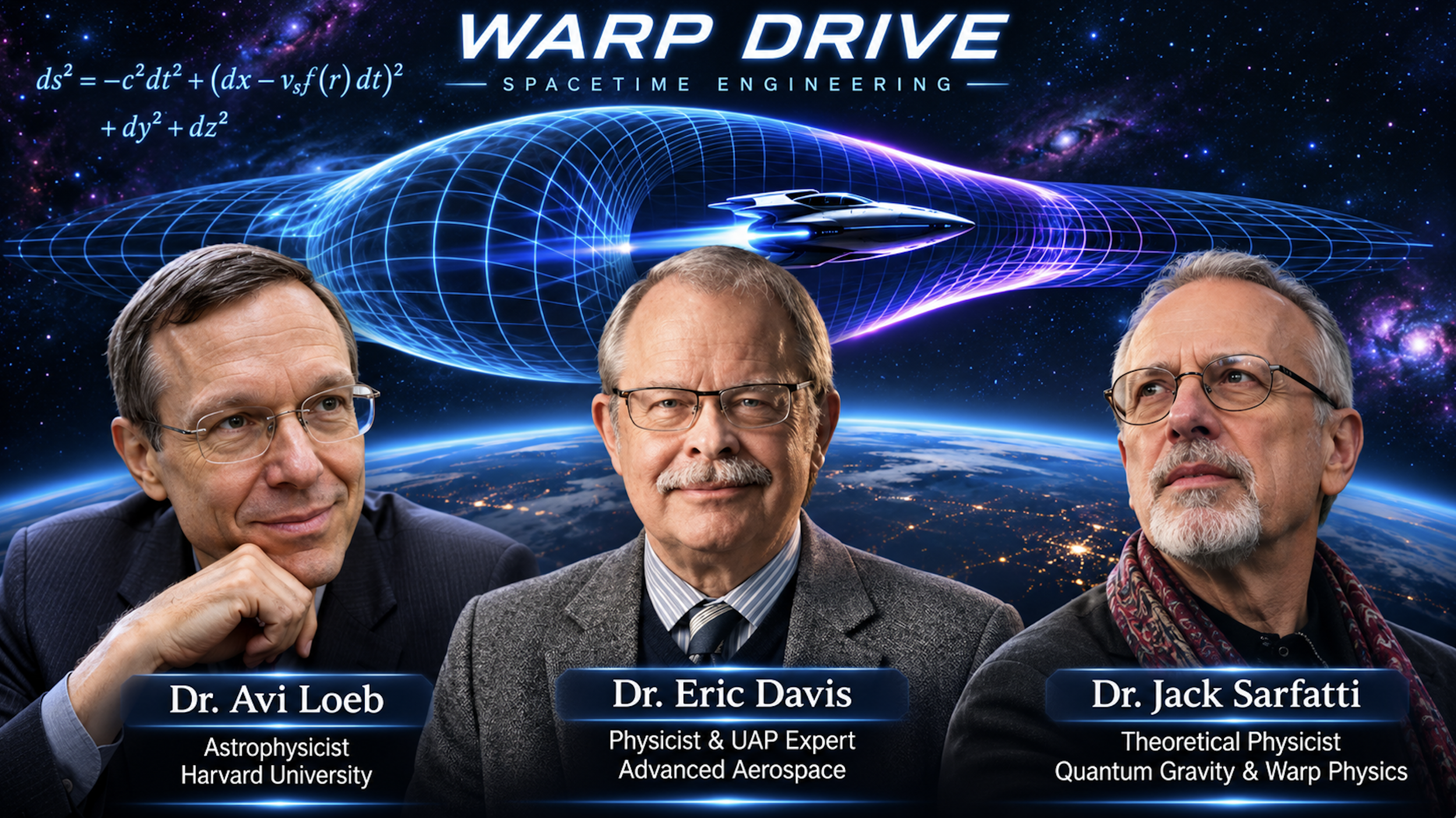
This is why warp drive is seriously discussed and studied by the likes of Avi Loeb, Eric Davis, and Jack Sarfartti.
But here is what is equally interesting regarding warp drive.
Warp drive does not just have a physics application but also provides a conceptual framework that we can metaphorically impart into our own lives when we ourselves are faced with the weight of resistance or adversity.
Humans are biologically wired to confront resistance and overcome obstacles that impede our forward progress. Therefore, we naturally meet these pushbacks with opposing force.
This trait is an evolutionary mechanism that encourages us to transform physical and psychological stress into opportunities for adaptation and growth to develop both competence and antifragility.
So, the thought of initiating change instead of using force may at first feel counterintuitive or unnatural, but theoretically, it does makes sense.
We can spend years beating our head against a wall trying to make a career path work or a relationship stable. We may tirelessly keep on keeping on, never relenting to the pressures as we fight against hindrances and hurdles.
But what happens when we suddenly realize that, despite the effort, we’ve merely remained in place – or moved backward?
Fortunately, there is another way.
If warp drive teaches us anything it is that altering the space around us can sometimes prove more effective than attempting to push through it using our sheer willpower.
And how do we change space?
Perhaps we need to reset our environment, reconsider our beliefs, or refocus our goals.
Maybe a relationship has run its course and it’s time to shift gears. Or maybe it’s the relationship with yourself – that melting pot of past experiences, outdated ideals, and other people’s opinions – that has reached a boiling point and requires some alteration.
Yes, there are times in life we must pursue and endure some possible discomfort in exchange for the potential reward.
There are, however, other times we should consider changing that which is holding us back by modifying space itself and allowing a new space such as a renewed dream, a fresh tone, or an altered plan to warp itself around us and take us for the ride of a lifetime!
So, by looking to the theory of warp drive as an example of how to benefit from mindset over muscle, surroundings over strength, there’s a good chance we can more quickly embark on an adapted path toward phenomenal things ahead.

When Gene Roddenberry pitched the first pilot of Star Trek in 1965, the studio immediately rejected it for being too slow and too cerebral.
Rather than re-pitching the same script to other studios thus forcing the original concept, Roddenberry reconsidered the pace and tone and rewrote the pilot to include more action and intrigue. The new direction was accepted, and Star Trek began its journey into our homes and psyches.
Roddenberry utilized change over force.
Isn’t it amazing how a fictional idea can morph into a real possibility and carry with it the kind of profound wisdom that only the universe can offer?
-LPS
Sources:
Title Image: Getty Images
Roddenberry, G. (Executive Producer). (1966–1969). Star Trek [TV series]. Desilu Productions; Paramount Television.
Miguel Alcubierre, "The warp drive: hyper-fast travel within general relativity," Classical and Quantum Gravity, Vol. 11, No. 5, pp. L73–L77 (1994).